
Pizza is today’s beloved dish enjoyed around the world in countless variations, from classic Margherita to inventive vegan options. While it feels like a modern staple, its roots stretch back thousands of years, deeply embedded in the culinary traditions of ancient civilizations. This comprehensive exploration uncovers the fascinating history behind the origins of pizza, revealing how ancient cultures contributed to the development of this iconic dish. Join us on a flavorful journey through time, discovering the earliest forms of flatbreads topped with various ingredients—precursors to the modern pizza.
- The Early Roots of Flatbreads in Ancient Civilizations
- Mesopotamian Flatbreads
- Egyptian Contributions
- Greek and Roman Innovations
- Ancient Greece: The Krepoundon
- Roman Pizzas and the Pinsa
- The Evolution of Pizza in the Medieval Period
- Arab Influence and the Use of Spices
- Early Forms of Pizza in Naples
- Introducing Tomatoes and Mozzarella: The Birth of Modern Pizza
- The Advent of Tomatoes in Europe
- The Creation of the Margherita Pizza
- Fundamental Ingredients and Techniques in Ancient and Medieval Pizzas
- Scientific Aspects of Pizza Preparation and Ingredients
- The Chemistry of Dough
- MARSHALL’S FORMULA FOR PERFECT PIZZA BASE
- Heat Influence and Maillard Reaction
- The Cultural Significance of Pizza Across Civilizations
- Food as a Ritual and Social Bond
- The Evolution Continues
- From Ancient Flatbreads to Global Phenomenon
The Early Roots of Flatbreads in Ancient Civilizations
The story of pizza begins long before the Italian version we recognize today. Ancient civilizations across Mesopotamia, Egypt, Greece, and the Roman Empire developed flatbreads—simple bread baked on hot stones or in clay ovens—that laid the foundation for future pizza dishes. These early culinary creations served both as everyday sustenance and festive offerings, showcasing ingenuity and local ingredients.
Mesopotamian Flatbreads
The cradle of civilization, ancient Mesopotamia, around 3000 BCE, saw the emergence of basic flatbreads. Archaeological findings reveal that Sumerians and Babylonians baked rudimentary breads using grains like barley and wheat, often topped with herbs, oil, or cheese. These ancient flatbreads might resemble early forms of pizza, serving as a portable and hearty meal for laborers and soldiers.
Egyptian Contributions
Ancient Egyptians, among the earliest to cultivate wheat and barley, also baked flatbreads as a staple food. In Egyptian tomb paintings, scenes depict bread baking and various toppings, suggesting a familiarity with adding ingredients to flatbreads. Some sources believe that the Egyptians prepared small, round, and topped breads as offerings to gods or as part of ritual feasts.
Greek and Roman Innovations
Ancient Greece: The Krepoundon
The Greeks developed their own version of flatbread, known as krepoundon, which was often seasoned with herbs, olive oil, and sometimes cheese. These breads were served with a variety of toppings, and later on, the Greeks added ingredients like onions and garlic, further refining the concept of flavored flatbreads.
Roman Pizzas and the Pinsa
The Romans took the tradition of flatbread further, creating dishes like the *pinsa*, a type of thick, doughy flatbread baked with various toppings—similar to modern focaccia. Roman soldiers and citizens enjoyed these early “pizza-like” foods, often flavored with herbs, cheese, and oil. Recipes from ancient Rome mention *panis focacius*, an early form of focaccia, which was a precursor to pizza.
The Evolution of Pizza in the Medieval Period
During the medieval era, the culinary landscape continued to evolve, particularly in Southern Italy. Here, the influence of different cultures—from Byzantines to Arabs—brought new ingredients and baking techniques, enriching the tradition of flatbreads.
Arab Influence and the Use of Spices
The Arab conquests in the Mediterranean introduced various spices and methods of bread-making to Southern Italy. Arab traders imported ingredients like turmeric and canola, which eventually found their way into local recipes. These influences enriched the flavor profiles of flatbreads, paving the way for more complex toppings.
Early Forms of Pizza in Naples
By the 17th and 18th centuries, Naples emerged as a significant hub for culinary innovation, including the development of pizza as we know it today. Street vendors sold simple flatbreads topped with tomatoes, garlic, oil, and cheese—cheap, portable, and filling—a food for the working classes and sailors.
Introducing Tomatoes and Mozzarella: The Birth of Modern Pizza
The Advent of Tomatoes in Europe
The most pivotal moment in pizza history occurred when tomatoes, native to the Americas, were introduced to Europe in the 16th century. Once thought to be poisonous, tomatoes gradually gained popularity, especially in Southern Italy. By the 18th century, they became a common ingredient in the Naples region, transforming the local flatbread tradition into something new and exciting.
The Creation of the Margherita Pizza
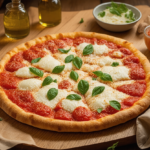
Legend credits Queen Margherita of Savoy with popularizing the iconic Margherita pizza around 1889. The pizza, featuring tomato, mozzarella, and basil—representing the red, white, and green of Italy’s flag—became a symbol of national pride and a staple of Neapolitan cuisine. This event marked the official birth of the modern pizza as a culinary art form.
Fundamental Ingredients and Techniques in Ancient and Medieval Pizzas
| Aspect | Ancient Civilizations | Medieval Italy | Modern Pizza |
|---|---|---|---|
| Common Base | Unleavened or lightly leavened flatbread baked on stones | Leavened dough, often thicker, baked in open ovens | Leavened dough with precise hygroscopic properties, baked at high temperatures |
| Key Ingredients | Grains, herbs, olive oil, cheese, sometimes honey or spices | Tomatoes (later), herbs, cheese, olive oil | Tomatoes, mozzarella, basil, olive oil, various toppings |
| Cooking Method | Baked on hot stones or in clay ovens | Wood-fueled ovens, open-flame baking | High-temperature commercial pizza ovens, often rotating |
Scientific Aspects of Pizza Preparation and Ingredients
The Chemistry of Dough
The dough’s structure hinges on gluten formation, which traps gas produced by yeast fermentation. The proportion of water, flour, yeast, and salt influences elasticity, rise, and texture. Modern recipes generally use a hydration level (water-to-flour ratio) of around 60-65%, facilitating stretchability and crispness.
MARSHALL’S FORMULA FOR PERFECT PIZZA BASE
To achieve ideal pizza dough, consider the formula below:
Dough Weight (g) = Flour + Water + Yeast + Salt + Olive Oil
Ideal hydration: 60-65%
Fermentation time: 1-2 days at controlled temperature
Heat Influence and Maillard Reaction
High-temperature baking (around 450-500°C in specialized ovens) triggers the Maillard reaction—a chemical process responsible for browning and flavor development. This process creates the characteristic aroma and crispy texture of well-made pizza crust.
The Cultural Significance of Pizza Across Civilizations
Food as a Ritual and Social Bond
Throughout history, flatbreads and their variants served as symbols of hospitality, community, and cultural identity. The act of sharing a flatbread was often imbued with social meaning—be it a ceremonial offering or a everyday communal meal.
The Evolution Continues
Today, pizza’s global popularity reflects its cultural adaptability. From traditional Neapolitan to American deep-dish and innovative gourmet styles, pizza remains a versatile dish rooted in ancient traditions yet continuously evolving. The blending of ingredients, techniques, and cultural influences perpetuates its legacy as a universal comfort food.
From Ancient Flatbreads to Global Phenomenon
The origins of pizza reveal a fascinating evolution driven by necessity, ingenuity, and cultural exchange. From humble flatbreads baked on stones in ancient Mesopotamia to the iconic Margherita of Naples, pizza embodies a culinary journey that spans millennia. It exemplifies how simple ingredients and traditional techniques can transcend time and geography, creating a dish that caters to every taste and culinary desire.
Understanding the rich history behind pizza not only enhances appreciation for this beloved dish but also inspires the creation of new, innovative recipes that honor centuries of culinary tradition. Whether enjoyed as a quick street snack or a gourmet masterpiece, pizza remains a testament to the universal human love for flavorful, shared meals.
Похожие записи:
 The Fascinating History of the First Recorded Pizza Recipe: From Ancient Origins to Modern Delight
  The History of Pizza Advertising Campaigns: From Origins to Modern Strategies
  The Evolution of Pizza Sauce Recipes Over Time: A Delicious Journey Through History
  Middle Eastern Lahmacun with Minced Meat and Herbs: A Delicious Journey Through Flavors and History The Delicious Evolution: The History of Pizza in Popular Music and Art Formations
  Finnish Karjalanpiirakka with Its Regional Twist: A Delicious Journey Through History and Variations The Regional Variations of Pizza Across Italy: A Culinary Journey The Invention of Deep-Dish Pizza in Chicago: A Delicious History
  Sicilian Pizza: A Delicious Dive into Thick, Square Slices and Its Rich History
  The History of Pizza Festivals and Competitions Worldwide
  The Cultural Adaptation of Pizza in Different Countries: A Global Culinary Journey
  The History and Evolution of Pizza Delivery Services: From Local Pizzerias to Global Giants
  The Rise of American-Style Pizza in the 20th Century: A Delicious Cultural Transformation
  Calzone: The Folded Pizza from Italy – A Delicious Journey into Italian Cuisine
  The Fascinating Journey of Pizza Chains and Their Worldwide Growth
  Scandinavian Rye-Based Flatbread Pizzas: A Delicious Twist on Traditional Pizza