
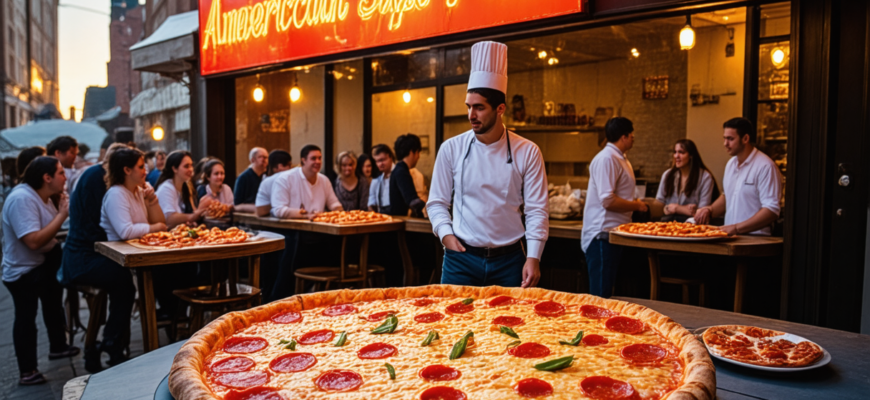
Pizza, originally a Neapolitan dish from Italy, has evolved dramatically and gained immense popularity across the United States during the 20th century. This culinary journey reflects not only changing tastes but also the rise of American ingenuity in adapting traditional recipes to local flavors and preferences. In this comprehensive article, we will explore the fascinating history of American-style pizza, its cultural significance, variations, and how it became a staple of American cuisine.
- Origins of Pizza: From Italy to America
- Traditional Italian Roots
- Introduction to America
- The Emergence of American-Style Pizza in the 20th Century
- Early Pizzerias and Regional Variations
- The Post-War Boom and Commercialization
- Characteristics of American-Style Pizza
- Types and Variations
- Common Ingredients and Cooking Methods
- The Cultural Impact of American-Style Pizza
- Pizza as a Cultural Icon
- Pizza and Social Life
- Mathematical Models and Formulas in Pizza Making
- Calculating Pizza Area
- Example:
- Cost-Performance Analysis
- Evolution of American Pizza Recipes
- Traditional vs. Contemporary Recipes
- The Enduring Appeal of American-Style Pizza
Origins of Pizza: From Italy to America
Traditional Italian Roots
Pizza’s roots trace back to ancient civilizations, with the modern form originating in Naples, Italy, during the late 18th and early 19th centuries. Initially, it was a simple, inexpensive meal for the working class, featuring flatbread topped with tomatoes, cheese, herbs, and other local ingredients. The famous Neapolitan pizza, characterized by its thin, soft crust and fresh toppings, became synonymous with Italian culinary tradition.
Introduction to America
Immigrants from Italy brought their culinary traditions to the United States in the late 19th and early 20th centuries. The first pizzerias in America appeared in cities with large Italian communities, such as New York City and Chicago. These early establishments maintained authentic recipes but gradually adapted to local tastes and ingredient availability, laying the groundwork for the distinctive American-style pizza.
The Emergence of American-Style Pizza in the 20th Century
Early Pizzerias and Regional Variations
In the early 1900s, the first American pizzerias served mainly Italian-American communities. The New York City style, characterized by thin, hand-tossed crusts and classic toppings like tomato sauce and mozzarella cheese, started gaining popularity. Meanwhile, Chicago introduced a hearty, deep-dish version that would change pizza’s cultural landscape forever.
The Post-War Boom and Commercialization
After World War II, pizza’s popularity soared across the United States. Soldiers returning from Italy and increased urbanization helped establish pizza as a fast, affordable, and delicious meal. Major chains like Domino’s, Pizza Hut, and Little Caesars emerged in the 1950s and 1960s, standardizing recipes and expanding pizza’s reach nationwide. This period marked the beginning of mass-produced, commercially available American-style pizza.
Characteristics of American-Style Pizza
Types and Variations
American-style pizza encompasses a wide array of regional variations, each with distinct features and flavor profiles. Here are some of the most popular:
- New York-Style Pizza: Thin, flexible crust, often sold by the slice, with a crispy edge and toppings like pepperoni, mushrooms, and onions.
- Chicago Deep-Dish Pizza: Thick, buttery crust with high edges, layered with cheese, meats, vegetables, and chunky tomato sauce, resembling a pie.
- California-Style Pizza: Emphasizes fresh, organic ingredients, with a thinner crust and creative toppings like goat cheese, avocado, and arugula.
- St. Louis-Style Pizza: Thin, cracker-like crust cut into squares, topped with special Provel cheese, a blend unique to St. Louis.
- Detroit-Style Pizza: Rectangular, thick crust with crispy edges, topped with cheese and sometimes caramelized on the edges through the baking process.
Common Ingredients and Cooking Methods
Despite regional differences, certain ingredients are staples across American pizzas:
- Crust: Ranges from thin and flexible to thick and doughy.
- Cheese: Traditionally mozzarella, but can include provolone, cheddar, and American cheese blends.
- Sauce: Typically tomato-based, with variations in seasoning and thickness.
- Toppings: Pepperoni, sausage, vegetables, olives, and even pineapple are common choices.
The Cultural Impact of American-Style Pizza
Pizza as a Cultural Icon
By the late 20th century, pizza became an integral part of American life, symbolizing American ingenuity and multicultural influences. It transcended its Italian origins to become a versatile dish that could be tailored to local tastes and dietary preferences, from vegetarian options to gluten-free crusts.
Pizza and Social Life
From school lunch programs and office parties to family gatherings and major sporting events, pizza is often associated with social bonding in the US. Its convenience and customization options made it a preferred choice for celebrations and casual meals alike.
Mathematical Models and Formulas in Pizza Making
Calculating Pizza Area
Understanding the size and portioning of pizzas relies on basic geometry. For a circular pizza, its area can be calculated as:
Area = π × r2
Where r is the radius of the pizza.
Example:
- Diameter of pizza = 16 inches
- Radius, r = D/2 = 8 inches
- Area = 3.1416 × 82 ≈ 3.1416 × 64 ≈ 201.06 square inches
Cost-Performance Analysis
To evaluate the best value of pizza sizes, one might compare the cost per square inch:
| Size | Diameter (inches) | Area (sq. inches) | Price ($) | Price per sq. inch ($) |
|---|---|---|---|---|
| Small | 12 | 113.1 | 8 | 0.0707 |
| Large | 16 | 201.1 | 15 | 0.0746 |
| Extra Large | 18 | 254.4 | 20 | 0.0785 |
Evolution of American Pizza Recipes
Traditional vs. Contemporary Recipes
While traditional recipes focused on simple ingredients, with an emphasis on quality and authenticity, modern American recipes often incorporate innovative toppings, crust styles, and dietary considerations. Here is a comparison:
| Aspect | Traditional American Pizza | Contemporary American Pizza |
|---|---|---|
| Crust | Thin, hand-tossed or deep-dish | Gluten-free, cauliflower crust, stuffed crust |
| Cheese | Mostly mozzarella | Blends with provolone, vegan cheese, dairy-free options |
| Sauce | Classic tomato sauce with herbs | Barbecue, garlic Alfredo, pesto bases |
| Toppings | Pepperoni, mushrooms, bell peppers | Artichokes, roasted vegetables, exotic meats |
The Enduring Appeal of American-Style Pizza
American-style pizza’s rise during the 20th century exemplifies how a traditional dish can be transformed by cultural exchange, innovation, and commercial development. Its versatility, regional diversity, and adaptability to modern dietary trends ensure that pizza remains a favorite food across generations. From the classic thin crust slices of New York to the hearty deep-dish pies of Chicago, American pizza is a testament to culinary creativity and cultural integration.
As the world continues to evolve, so does the pizza scene in America, constantly introducing new recipes, flavors, and techniques. Whether traditional or avant-garde, one thing remains certain: pizza’s cultural footprint is as vibrant and welcoming as ever, promising delicious experiences for every taste.
Похожие записи:
 New York-Style Thin Crust Pizza: The Iconic Street Food of the Big Apple
  The Influence of Italian Immigrants on Global Pizza Culture
  Discovering Czech Pizza: Delicious Variations and Traditional Toppings
  Brazilian Pizza with Unique Tropical Ingredients: A Delicious Fusion of Flavors
  Calzone: The Folded Pizza from Italy – A Delicious Journey into Italian Cuisine
  Swedish Spritz with Its Thin Crust and Savory Toppings: A Delicious Twist in Pizza Styles
  Sicilian Pizza: A Delicious Dive into Thick, Square Slices and Its Rich History
  Margarita Pizza: Italy’s Timeless Classic
  Neapolitan Pizza: The Art of Authentic Preparation
  Roman Pizza al Taglio and Its Rectangular Slices: A Deep Dive into Tradition, Technique, and Tastes
  Scandinavian Rye-Based Flatbread Pizzas: A Delicious Twist on Traditional Pizza
  Maltese Ftira with Local Flavors: A Delicious Twist on Traditional Pizza
  Croatian Pizza with Mediterranean Influences: A Culinary Journey
  Discover the Bold Flavors of Serbian Pizza with Spicy Sausage and Peppers
  South African Queen Pizza with Local Flavors: A Tasty Fusion of Tradition and Innovation
  Chicago Deep-Dish Pizza and Its Hearty Layers: A Delicious Journey into Its Unique Structure